Creeping Crawling Thing Art Piece Bird Made of Hands

Hieronymus Bosch, The Garden of Earthly Delights, oil on oak panels, 205.v cm × 384.ix cm (81 in × 152 in), Museo del Prado, Madrid
The Garden of Earthly Delights is the mod championship[a] given to a triptych oil painting on oak panel painted by the Early Netherlandish master Hieronymus Bosch, betwixt 1490 and 1510, when Bosch was between 40 and 60 years old.[1] It has been housed in the Museo del Prado in Madrid, Espana since 1939.
Equally picayune is known of Bosch's life or intentions, interpretations of his intent range from an admonition of worldly fleshy indulgence, to a dire alarm on the perils of life'southward temptations, to an evocation of ultimate sexual joy. The intricacy of its symbolism, particularly that of the central panel, has led to a wide range of scholarly interpretations over the centuries. Twentieth-century fine art historians are divided as to whether the triptych's central panel is a moral warning or a panorama of paradise lost.
Bosch painted 3 big triptychs (the others are The Last Judgment of c. 1482 and The Haywain Triptych of c. 1516) that tin can be read from left to correct and in which each panel was essential to the meaning of the whole. Each of these iii works presents distinct nevertheless linked themes addressing history and religion. Triptychs from this menstruum were generally intended to be read sequentially, the left and correct panels often portraying Eden and the Last Judgment respectively, while the principal discipline was independent in the center piece.[2] Information technology is not known whether The Garden was intended as an altarpiece, merely the full general view is that the extreme subject matter of the inner center and right panels make information technology unlikely that it was intended to function in a church or monastery, but was instead commissioned by a lay patron.[3]
Clarification [edit]
Exterior [edit]

The exterior panels show the world during creation, probably on the Tertiary 24-hour interval, afterwards the addition of establish life merely before the appearance of animals and humans.[4]
When the triptych's wings are airtight, the pattern of the outer panels becomes visible. Rendered in a green–gray grisaille,[five] these panels lack colour, probably because most Netherlandish triptychs were thus painted, but possibly indicating that the painting reflects a fourth dimension before the creation of the lord's day and moon, which were formed, according to Christian theology, to "give calorie-free to the earth".[6] The typical grisaille blandness of Netherlandish altarpieces served to highlight the fantabulous colour within.[7]
The outer panels are by and large thought to depict the creation of the world,[viii] showing greenery beginning to clothe the still-pristine Earth.[nine] God, wearing a crown similar to a papal tiara (a common convention in Netherlandish painting),[6] is visible as a tiny figure at the upper left. Bosch shows God as the begetter sitting with a Bible on his lap, creating the Earth in a passive manner by divine fiat.[x] Above him is inscribed a quote from Psalm 33 reading "Ipse dīxit, et facta sunt: ipse mandāvit, et creāta sunt"—For he spake and it was done; he commanded, and information technology stood fast.[eleven] The Globe is encapsulated in a transparent sphere recalling the traditional depiction of the created world every bit a crystal sphere held by God or Christ.[12] It hangs suspended in the cosmos, which is shown equally an impermeable darkness, whose only other inhabitant is God himself.[six]
Despite the presence of vegetation, the earth does non yet contain homo or animal life, indicating that the scene represents the events of the biblical Third Day.[4] Bosch renders the plant life in an unusual manner, using uniformly gray tints which make information technology hard to decide whether the subjects are purely vegetable or perhaps include some mineral formations.[four] Surrounding the interior of the world is the bounding main, partially illuminated past beams of light shining through clouds. The outside wings have a articulate position inside the sequential narrative of the work as a whole. They bear witness an unpopulated globe composed solely of stone and plants, contrasting sharply with the inner primal panel which contains a paradise teeming with lustful humanity.
Interior [edit]
Left panel

Centre console

Right console
Scholars have proposed that Bosch used the outer panels to establish a Biblical setting for the inner elements of the work,[5] and the outside image is generally interpreted as set in an earlier time than those in the interior. As with Bosch'due south Haywain Triptych, the inner centerpiece is flanked by heavenly and hellish imagery. The scenes depicted in the triptych are thought to follow a chronological society: flowing from left-to-right they represent Eden, the garden of earthly delights, and Hell.[13] God appears as the creator of humanity in the left hand wing, while the consequences of humanity's failure to follow his will are shown in the correct.

Naked figures seek pleasure in diverse ways. Eye panel, women with peacock (particular)
Nevertheless, in dissimilarity to Bosch'southward two other complete triptychs, The Last Judgment (around 1482) and The Haywain (after 1510), God is absent from the central console. Instead, this panel shows humanity interim with apparent gratis will as naked men and women appoint in various pleasance-seeking activities. According to some interpretations, the right hand panel is believed to show God's penalties in a hellscape.[fourteen]
Fine art historian Charles de Tolnay believed that, through the seductive gaze of Adam, the left panel already shows God's waning influence upon the newly created earth. This view is reinforced by the rendering of God in the outer panels every bit a tiny figure in comparison to the immensity of the globe.[13] According to Hans Belting, the three inner panels seek to broadly convey the Old Testament notion that, before the Fall, there was no divers purlieus between practiced and evil; humanity in its innocence was unaware of upshot.[15]
Left console [edit]

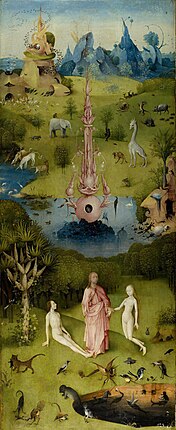
The left panel (sometimes known equally the Joining of Adam and Eve)[17] depicts a scene from the paradise of the Garden of Eden commonly interpreted as the moment when God presents Eve to Adam. The painting shows Adam waking from a deep slumber to find God belongings Eve past her wrist and giving the sign of his blessing to their union. God is younger-looking than on the outer panels, blue-eyed and with gilded curls. His youthful appearance may be a device by the artist to illustrate the concept of Christ as the incarnation of the Word of God.[xviii] God'southward correct hand is raised in blessing, while he holds Eve'southward wrist with his left. According to the work's most controversial interpreter, the 20th-century folklorist and art historian Wilhelm Fraenger:
Equally though enjoying the pulsation of the living claret and as though too he were setting a seal on the eternal and immutable communion between this human claret and his own. This physical contact betwixt the Creator and Eve is repeated even more noticeably in the way Adam's toes touch the Lord's foot. Hither is the stressing of a rapport: Adam seems indeed to be stretching to his full length in lodge to make contact with the Creator. And the billowing out of the cloak around the Creator's heart, from where the garment falls in marked folds and contours to Adam'south feet, also seems to indicate that here a current of divine power flows downward, so that this group of three actually forms a closed excursion, a circuitous of magical energy ...[xix]
Eve avoids Adam's gaze, although, co-ordinate to Walter S. Gibson, she is shown "seductively presenting her body to Adam".[20] Adam's expression is one of amazement, and Fraenger has identified three elements to his seeming astonishment. Firstly, there is surprise at the presence of the God. Secondly, he is reacting to an awareness that Eve is of the same nature as himself, and has been created from his ain body. Finally, from the intensity of Adam's gaze, it can exist ended that he is experiencing sexual arousal and the primal urge to reproduce for the offset time.[21]
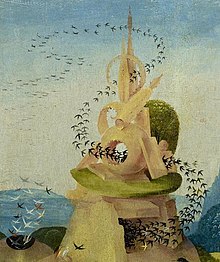
Birds swarming through cavities of a hut-shaped course in the left background of the left panel
The surrounding landscape is populated by hut-shaped forms, some of which are made from rock, while others are at least partially organic. Behind Eve rabbits, symbolising fecundity, play in the grass, and a dragon tree reverse is thought to represent eternal life.[twenty] The background reveals several animals that would have been exotic to contemporaneous Europeans, including a giraffe, a monkey riding an elephant, and a lion that has killed and is near to devour his prey. In the foreground, from a big hole in the basis, sally birds and winged animals, some of which are realistic, some fantastic. Behind a fish, a person clothed in a curt-sleeved hooded jacket and with a duck'southward nib holds an open book as if reading. To the left of the surface area a cat holds a small lizard-like beast in its jaws. Belting observes that, despite the fact that the creatures in the foreground are fantastical imaginings, many of the animals in the mid and background are drawn from gimmicky travel literature, and hither Bosch is appealing to "the knowledge of a humanistic and aristocratic readership".[22] Erhard Reuwich'southward pictures for Bernhard von Breydenbach's 1486 Pilgrimages to the Holy Land were long thought to be the source for both the elephant and the giraffe, though more recent research indicates the mid-15th-century humanist scholar Cyriac of Ancona's travelogues served equally Bosch's exposure to these exotic animals.[22]
According to fine art historian Virginia Tuttle, the scene is "highly anarchistic [and] cannot be identified as whatever of the events from the Volume of Genesis traditionally depicted in Western art".[23] Some of the images contradict the innocence expected in the Garden of Eden. Tuttle and other critics take interpreted the gaze of Adam upon his wife as lustful, and indicative of the Christian belief that humanity was doomed from the outset.[23] Gibson believes that Adam's facial expression betrays non just surprise but besides expectation. According to a belief mutual in the Middle Ages, before the Fall Adam and Eve would take copulated without lust, solely to reproduce. Many believed that the get-go sin committed after Eve tasted the forbidden fruit was carnal lust.[24] On a tree to the right a ophidian curls around a tree trunk, while to its right a mouse creeps; according to Fraenger, both animals are universal phallic symbols.[25]
Center panel [edit]

The central water-leap globe in the middle panel's upper background is a hybrid of stone and organic matter. It is adorned by nude figures cavorting both with each other and with various creatures, some of whom are realistic, others are fantastic or hybrid.
The skyline of the centre panel (220 × 195 cm, 87 × 77 in) matches exactly with that of the left wing, while the positioning of its central puddle and the lake behind it echoes the lake in the earlier scene. The center epitome depicts the expansive "garden" landscape which gives the triptych its name. The panel shares a mutual horizon with the left fly, suggesting a spatial connexion between the two scenes.[26] The garden is teeming with male and female person nudes, together with a variety of animals, plants and fruit.[27] The setting is not the paradise shown in the left panel, but neither is it based in the terrestrial realm.[28] Fantastic creatures mingle with the real; otherwise ordinary fruits appear engorged to a gigantic size. The figures are engaged in diverse amorous sports and activities, both in couples and in groups. Gibson describes them equally behaving "overtly and without shame",[29] while art historian Laurinda Dixon writes that the man figures exhibit "a sure adolescent sexual curiosity".[17]
Many of the numerous homo figures revel in an innocent, cocky-absorbed joy as they engage in a wide range of activities; some appear to bask sensory pleasures, others play unselfconsciously in the water, and yet others cavort in meadows with a variety of animals, seemingly at one with nature. In the middle of the background, a large blue globe resembling a fruit pod rises in the eye of a lake. Visible through its round window is a man holding his right hand close to his partner's genitals, and the blank buttocks of still some other figure hover in the vicinity. According to Fraenger, the eroticism of the middle frame could exist considered either as an allegory of spiritual transition or a playground of corruption.[xxx]

A group of nude females from the center panel. The head of one female is adorned with two cherries—a symbol of pride. To her right, a male drinks lustfully from an organic vessel. Behind the group, a male carries a couple encased in a mussel beat out.[31]
On the right-paw side of the foreground stand a grouping of four figures, three white- and ane black-skinned. The white-skinned figures, two males and one female person, are covered from head to foot in light-chocolate-brown body hair. Scholars more often than not agree that these hirsute figures represent wild or primeval humanity, but disagree on the symbolism of their inclusion. Art historian Patrik Reuterswärd, for example, posits that they may be seen as "the noble savage" who represents "an imagined alternative to our civilized life", imbuing the console with "a more clear-cutting primitivistic note".[32] Writer Peter Glum, in contrast, sees the figures as intrinsically connected with whoredom and lust.[33]
In a cave to their lower correct, a male person figure points towards a reclining female who is also covered in pilus. The pointing homo is the only clothed figure in the console, and as Fraenger observes, "he is clothed with emphatic austerity right up to his pharynx".[34] In addition, he is one of the few man figures with dark hair. According to Fraenger:
The mode this human'south dark hair grows, with the sharp dip in the middle of his high forehead, as though concentrating there all the free energy of the masculine K, makes his confront unlike from all the others. His coal-black eyes are rigidly focused in a gaze that expresses compelling strength. The nose is unusually long and boldly curved. The mouth is wide and sensual, but the lips are firmly close in a directly line, the corners strongly marked and tightened into final points, and this strengthens the impression—already suggested past the eyes—of a strong controlling volition. It is an extraordinarily fascinating confront, reminding the states of faces of famous men, peculiarly of Machiavelli'southward; and indeed the whole aspect of the head suggests something Mediterranean, every bit though this man had acquired his frank, searching, superior air at Italian academies.[34]
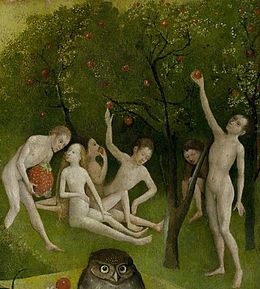
A group of figures pluck fruit from a tree. A homo carries a big strawberry, while an owl is in the foreground.
The pointing man has variously been described every bit either the patron of the work (Fraenger in 1947), every bit an advocate of Adam denouncing Eve (Dirk Bax in 1956), as Saint John the Baptist in his camel's skin (Isabel Mateo Goméz in 1963),[35] or as a self-portrait.[15] The woman below him lies within a semicylindrical transparent shield, while her oral fissure is sealed, devices implying that she bears a secret. To their left, a man crowned by leaves lies on top of what appears to be an actual merely gigantic strawberry, and is joined by a male and female person who contemplate some other equally huge strawberry.[35]
There is no perspectival club in the foreground; instead it comprises a series of modest motifs wherein proportion and terrestrial logic are abandoned. Bosch presents the viewer with gigantic ducks playing with tiny humans nether the cover of oversized fruit; fish walking on land while birds dwell in the water; a passionate couple encased in an amniotic fluid bubble; and a man inside of a blood-red fruit staring at a mouse in a transparent cylinder.[36]
The pools in the fore and background contain bathers of both sexes. In the key circular puddle, the sexes are more often than not segregated, with several females adorned by peacocks and fruit.[31] Four women carry cherry-red-similar fruits on their heads, maybe a symbol of pride at the time, equally has been deduced from the contemporaneous proverb: "Don't swallow cherries with great lords—they'll throw the pits in your face."[37] The women are surrounded by a parade of naked men riding horses, donkeys, unicorns, camels and other exotic or fantastic creatures.[28] Several men show acrobatics while riding, apparently acts designed to proceeds the females' attention, which highlights the allure felt between the two sexes as groups.[31] The 2 outer springs besides contain both men and women cavorting with abandon. Effectually them, birds infest the water while winged fish clamber on land. Humans inhabit giant shells. All are surrounded by oversized fruit pods and eggshells, and both humans and animals banquet on strawberries and cherries.
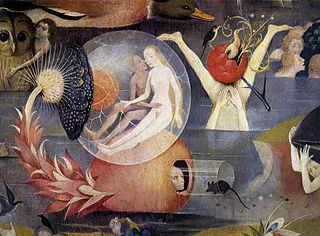
Detail showing nudes inside a transparent sphere, which is the fruit of a plant
The impression of a life lived without effect, or what art historian Hans Belting describes as "unspoilt and pre-moral being", is underscored by the absence of children and old people.[38] Co-ordinate to the second and third capacity of Genesis, Adam and Eve's children were born after they were expelled from Eden. This has led some commentators, in particular Belting, to theorise that the panel represents the world if the two had not been driven out "amongst the thorns and thistles of the earth". In Fraenger'due south view, the scene illustrates "a utopia, a garden of divine delight earlier the Fall, or—since Bosch could not deny the existence of the dogma of original sin—a millennial status that would arise if, after expiation of Original Sin, humanity were permitted to render to Paradise and to a state of tranquil harmony embracing all Creation."[39]
In the loftier distance of the background, to a higher place the hybrid stone formations, four groups of people and creatures are seen in flying. On the firsthand left a human male rides on a chthonic solar hawkeye-lion. The human carries a triple-branched tree of life on which perches a bird; co-ordinate to Fraenger "a symbolic bird of death". Fraenger believes the man is intended to stand for a genius, "he is the symbol of the extinction of the duality of the sexes, which are resolved in the ether into their original state of unity".[40] To their right a knight with a dolphin tail sails on a winged fish. The knight'due south tail curls back to touch the back of his caput, which references the common symbol of eternity: the snake biting its ain tail. On the immediate right of the console, a winged youth soars upwardly carrying a fish in his hands and a falcon on his back.[40] According to Belting, in these passages Bosch's "imagination triumphs ... the ambivalence of [his] visual syntax exceeds even the enigma of content, opening up that new dimension of freedom by which painting becomes fine art."[15] Fraenger titled his chapter on the high background "The Rising to Heaven", and wrote that the airborne figures were probable intended as a link between "what is in a higher place" and "what is beneath", just as the left and right hand panels stand for "what was" and "what volition be".[41]
Right panel [edit]
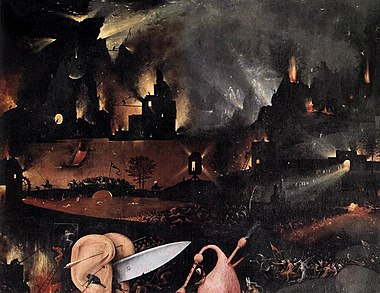
A scene from the hellscape console showing the long beams of light emitted from the burning city in the panel's groundwork[18]
The correct panel (220 × 97.5 cm, 87 × 38.4 in) illustrates Hell, the setting of a number of Bosch paintings. Bosch depicts a world in which humans have succumbed to temptations that pb to evil and reap eternal damnation. The tone of this final console strikes a harsh contrast to those preceding it. The scene is set at night, and the natural dazzler that adorned the earlier panels is noticeably absent. Compared to the warmth of the center console, the right fly possesses a chilling quality—rendered through cold colourisation and frozen waterways—and presents a tableau that has shifted from the paradise of the heart image to a spectacle of cruel torture and retribution.[42] In a single, densely detailed scene, the viewer is fabricated witness to cities on fire in the background; war, torture chambers, infernal taverns, and demons in the midground; and mutated animals feeding on human flesh in the foreground.[43] The nakedness of the human figures has lost all its eroticism, and many now attempt to cover their ballocks and breasts with their hands, ashamed by their nakedness.[18]
Large explosions in the groundwork throw light through the urban center gates and spill into the h2o in the midground; according to writer Walter S. Gibson, "their fiery reflection turning the water beneath into claret".[18] The light illuminates a route filled with fleeing figures, while hordes of tormentors prepare to burn a neighbouring village.[44] A curt altitude away, a rabbit carries an impaled and bleeding corpse, while a group of victims above are thrown into a called-for lantern.[45] The foreground is populated by a diverseness of distressed or tortured figures. Some are shown vomiting or excreting, others are crucified by harp and lute, in an allegory of music, thus sharpening the contrast betwixt pleasure and torture. A choir sings from a score inscribed on a pair of buttocks,[42] part of a grouping that has been described as the "Musicians' Hell".[46]

The "Tree-Human being" of the right panel, and a pair of man ears brandishing a blade. A crenel in the torso is populated by three naked persons at a table, seated on an brute, and a fully clothed woman pouring drink from a barrel.
The focal point of the scene is the "Tree-Man", whose clangorous body is supported by what could be contorted artillery or rotting tree trunks. His caput supports a disk populated by demons and victims parading around a huge set of bagpipes—ofttimes used as a dual sexual symbol[42]—reminiscent of human scrotum and penis. The tree-man's torso is formed from a broken eggshell, and the supporting torso has thorn-like branches which pierce the delicate body. A greyness figure in a hood bearing an arrow jammed between his buttocks climbs a ladder into the tree-man's central cavity, where nude men sit in a tavern-similar setting. The tree-man gazes outwards across the viewer, his conspiratorial expression a mix of wistfulness and resignation.[47] Belting wondered if the tree-man's face is a self-portrait, citing the figure'southward "expression of irony and the slightly sideways gaze [which would] then constitute the signature of an creative person who claimed a bizarre pictorial earth for his own personal imagination".[42]
Many elements in the console comprise earlier iconographical conventions depicting hell. However, Bosch is innovative in that he describes hell not as a fantastical place, merely every bit a realistic world containing many elements from day-to-day human life.[43]

Gibson compares this "Prince of Hell" to a figure in the twelfth-century Irish gaelic religious text Vision of Tundale, who feeds on the souls of decadent and carnal clergy.[47]
Animals are shown punishing humans, subjecting them to nightmarish torments that may symbolise the vii deadly sins, matching the torment to the sin. Sitting on an object that may exist a toilet or a throne, the panel's centerpiece is a gigantic bird-headed monster feasting on homo corpses, which he excretes through a crenel beneath him,[43] into the transparent chamber pot on which he sits.[47] The monster is sometimes referred to as the "Prince of Hell", a name derived from the cauldron he wears on his caput, perhaps representing a debased crown.[43] At his feet, a female has her face reflected on the buttocks of a demon. Farther to the left, next to a hare-headed demon, a group of naked persons around a toppled gambling table are being massacred with swords and knives. Other brutal violence is shown by a knight torn downwardly and eaten up by a pack of wolves to the correct of the tree-man.
During the Eye Ages, sexuality and lust were seen, past some, as evidence of humanity's autumn from grace. In the eyes of some viewers, this sin is depicted in the left-hand panel through Adam'due south, allegedly lustful, gaze towards Eve, and it has been proposed that the center console was created as a warning to the viewer to avoid a life of sinful pleasance.[48] According to this view, the penalty for such sins is shown in the right console of the triptych. In the lower right-hand corner, a man is approached by a grunter wearing the veil of a nun. The hog is shown trying to seduce the human to sign legal documents. Lust is further said to exist symbolised by the gigantic musical instruments and by the choral singers in the left foreground of the panel. Musical instruments often carried erotic connotations in works of art of the period, and animalism was referred to in moralising sources as the "music of the flesh". In that location has also been the view that Bosch's employ of music here might be a rebuke against traveling minstrels, ofttimes idea of as purveyors of bawdy song and poesy.[49]
Dating and provenance [edit]
The dating of The Garden of Earthly Delights is uncertain. Ludwig von Baldass (1917) considered the painting to be an early piece of work past Bosch.[50] Yet, since De Tolnay (1937)[51] consensus amongst 20th-century art historians placed the work in 1503–1504 or fifty-fifty afterwards. Both early and late datings were based on the "archaic" handling of space.[52] Dendrochronology dates the oak of the panels between the years 1460 and 1466, providing an earliest date (terminus post quem) for the work.[53] Wood used for console paintings during this period customarily underwent a lengthy period of storage for seasoning purposes, so the historic period of the oak might be expected to predate the actual date of the painting by several years. Internal show, specifically the depiction of a pineapple (a "New World" fruit), suggests that the painting itself postdates Columbus' voyages to the Americas, betwixt 1492 and 1504.[53] The dendrochronological research brought Vermet[54] to reconsider an early on dating and, consequently, to dispute the presence of whatever "New Earth" objects, stressing the presence of African ones instead.[55]
The Garden was first documented in 1517, 1 twelvemonth subsequently the artist'south death, when Antonio de Beatis, a canon from Molfetta, Italy, described the work as part of the decoration in the town palace of the Counts of the House of Nassau in Brussels.[56] The palace was a high-profile location, a house oft visited by heads of state and leading court figures. The prominence of the painting has led some to conclude that the work was commissioned, and non "solely ... a flight of the imagination".[57] A description of the triptych in 1605 chosen it the "strawberry painting", because the fruit of the strawberry tree (madroño in Spanish) features prominently in the center panel. Early on Spanish writers referred to the work as La Lujuria ("Lust").[52]
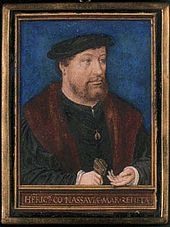
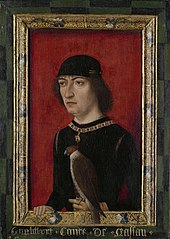
The aristocracy of the Burgundian Netherlands, influenced past the humanist movement, were the most likely collectors of Bosch's paintings, but there are few records of the location of his works in the years immediately following his decease.[58] It is likely that the patron of the piece of work was Engelbrecht 2 of Nassau, who died in 1504, or his successor Henry 3 of Nassau-Breda, the governor of several of the Habsburg provinces in the Low Countries. De Beatis wrote in his travel journal that "in that location are some panels on which bizarre things have been painted. They represent seas, skies, woods, meadows, and many other things, such every bit people crawling out of a shell, others that bring forth birds, men and women, white and blacks doing all sorts of different activities and poses."[59] Because the triptych was publicly displayed in the palace of the House of Nassau, it was visible to many, and Bosch's reputation and fame quickly spread across Europe. The work'southward popularity can be measured by the numerous surviving copies—in oil, engraving and tapestry—deputed by wealthy patrons, every bit well every bit past the number of forgeries in circulation after his expiry.[60] Most are of the cardinal panel merely and practice not deviate from the original. These copies were commonly painted on a much smaller calibration, and they vary considerably in quality. Many were created a generation later Bosch, and some took the grade of wall tapestries.[61]
The De Beatis clarification, simply rediscovered by Steppe in the 1960s,[56] cast new light on the commissioning of a work that was previously thought—since it has no key religious prototype—to be an atypical altarpiece. Many Netherlandish diptychs intended for private use are known, and fifty-fifty a few triptychs, but the Bosch panels are unusually large compared with these and contain no donor portraits. Perhaps they were deputed to celebrate a wedding, as large Italian paintings for private houses often were.[62] Even so, The Garden 's bold depictions do non dominion out a church committee, such was the contemporaneous fervor to warn against immorality.[52] In 1566, the triptych served every bit the model for a tapestry that hangs at El Escorial monastery near Madrid.[63]
Upon the decease of Henry Three, the painting passed into the hands of his nephew William the Silent, the founder of the House of Orangish-Nassau and leader of the Dutch Revolt against Spain. In 1568, however, the Knuckles of Alba confiscated the picture and brought it to Spain,[64] where it became the property of 1 Don Fernando, the Duke's illegitimate son and heir and the Castilian commander in the Netherlands.[65] Philip 2 acquired the painting at auction in 1591; two years later he presented information technology to El Escorial. A contemporaneous description of the transfer records the souvenir on 8 July 1593[52] of a "painting in oils, with two wings depicting the diverseness of the world, illustrated with grotesqueries past Hieronymus Bosch, known as 'Del Madroño'".[66] After an unbroken 342 years at El Escorial, the work moved to the Museo del Prado in 1939,[67] along with other works past Bosch. The triptych was not particularly well-preserved; the paint of the middle console especially had flaked off around joints in the wood.[52] However, recent restoration works have managed to recover and maintain information technology in a very good state of quality and preservation.[68] The painting is ordinarily on brandish in a room with other works by Bosch.[69]
Sources and context [edit]
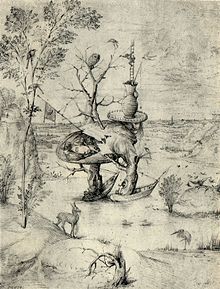
Hieronymus Bosch, Homo Tree, c. 1470s. The "Tree-Homo" of the right-manus console, depicted in an before drawing by Bosch. This pen and bistre version contains no proffer of Hell, yet its outline was adapted into 1 of The Garden 's most memorable grotesques.[42]
Piffling is known for certain of the life of Hieronymus Bosch or of the commissions or influences that may take formed the basis for the iconography of his work. His birthdate, education and patrons remain unknown. In that location is no surviving record of Bosch's thoughts or bear witness as to what attracted and inspired him to such an private way of expression.[70] Through the centuries art historians have struggled to resolve this question yet conclusions remain fragmentary at best. Scholars have debated Bosch's iconography more extensively than that of whatsoever other Netherlandish artist.[71] His works are generally regarded equally enigmatic, leading some to speculate that their content refers to contemporaneous esoteric noesis since lost to history.
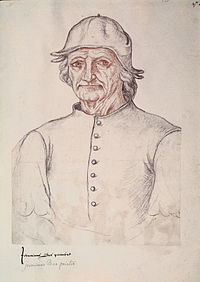
Hieronymus Bosch, in a c. 1550 drawing once idea to exist a copy of a self-portrait. His age in this representation (believed to be around 60 years) has been used to gauge his date of nativity, although its attribution remains uncertain.[72]
Although Bosch's career flourished during the Loftier Renaissance, he lived in an area where the beliefs of the medieval Church even so held moral authority.[73] He would have been familiar with some of the new forms of expression, especially those in Southern Europe, although it is hard to attribute with certainty which artists, writers and conventions had a bearing on his work.[71] José de Sigüenza is credited with the commencement extensive critique of The Garden of Earthly Delights, in his 1605 History of the Club of St. Jerome.[74] He argued against dismissing the painting as either heretical or merely absurd, commenting that the panels "are a satirical annotate on the shame and sinfulness of flesh".[74] The art historian Carl Justi observed that the left and middle panels are drenched in tropical and oceanic temper, and concluded that Bosch was inspired by "the news of recently discovered Atlantis and by drawings of its tropical scenery, just as Columbus himself, when approaching terra firma, thought that the identify he had found at the mouth of the Orinoco was the site of the Earthly Paradise".[75] The period in which the triptych was created was a fourth dimension of adventure and discovery, when tales and trophies from the New World sparked the imagination of poets, painters and writers.[76] Although the triptych contains many unearthly and fantastic creatures, Bosch notwithstanding appealed in his images and cultural references to an elite humanist and aristocratic audience. Bosch reproduces a scene from Martin Schongauer's engraving Flight into Egypt.[77]
Conquest in Africa and the East provided both wonder and terror to European intellectuals, as it led to the decision that Eden could never take been an bodily geographical location. The Garden references exotic travel literature of the 15th century through the animals, including lions and a giraffe, in the left panel. The giraffe has been traced to Cyriac of Ancona, a travel writer known for his visits to Arab republic of egypt during the 1440s. The exoticism of Cyriac's sumptuous manuscripts may accept inspired Bosch'southward imagination.[78]

The giraffe on the right side of the left panel may be drawn from copies of those in Cyriac of Ancona's Egyptian Voyage (left), which was published c. 1440.[22]
The charting and conquest of this new world fabricated real regions previously only idealised in the imagination of artists and poets. At the same fourth dimension, the certainty of the old biblical paradise began to sideslip from the grasp of thinkers into the realms of mythology. In response, treatment of the Paradise in literature, poesy and art shifted towards a cocky-consciously fictional Utopian representation, every bit exemplified by the writings of Thomas More (1478–1535).[79]
Albrecht Dürer was an avid student of exotic animals, and drew many sketches based on his visits to European zoos. Dürer visited 's-Hertogenbosch during Bosch'due south lifetime, and it is likely the 2 artists met, and that Bosch drew inspiration from the High german's work.[80]
Attempts to find sources for the work in literature from the menses take non been successful. Fine art historian Erwin Panofsky wrote in 1953 that, "In spite of all the ingenious, brainy and in part extremely useful inquiry devoted to the chore of "decoding Jerome Bosch", I cannot assist feeling that the real surreptitious of his magnificent nightmares and daydreams has however to be disclosed. Nosotros have bored a few holes through the door of the locked room; simply somehow nosotros exercise not seem to accept discovered the key."[81] [82] The humanist Desiderius Erasmus has been suggested as a possible influence; the writer lived in 'due south-Hertogenbosch in the 1480s, and it is likely he knew Bosch. Glum remarked on the triptych's similarity of tone with Erasmus's view that theologians "explicate (to suit themselves) the most difficult mysteries ... is it a possible proposition: God the Begetter hates the Son? Could God have assumed the form of a woman, a devil, an ass, a gourd, a rock?"[83]
Interpretation [edit]

Item from the middle panel showing two cherry-red-adorned dancing figures who carry a surface on which an owl is perched. In the front end right corner a bird standing on a reclining human'due south foot is nigh to eat from a cherry offered to information technology.
Because but bare details are known of Bosch's life, interpretation of his work can be an extremely hard expanse for academics as it is largely reliant on conjecture. Individual motifs and elements of symbolism may exist explained, just so far relating these to each other and to his work as a whole has remained elusive.[17] The enigmatic scenes depicted on the panels of the inner triptych of The Garden of Earthly Delights have been studied by many scholars, who have often arrived at contradictory interpretations.[59] Analyses based on symbolic systems ranging from the alchemical, astrological, and heretical to the folkloric and subconscious take all attempted to explain the complex objects and ideas presented in the piece of work.[84] Until the early 20th century, Bosch'southward paintings were generally thought to incorporate attitudes of Medieval didactic literature and sermons. Charles De Tolnay wrote that
The oldest writers, Dominicus Lampsonius and Karel van Mander, attached themselves to his near evident side, to the subject field; their formulation of Bosch, inventor of fantastic pieces of devilry and of infernal scenes, which prevails today (1937) in the public at large, and prevailed with historians until the terminal quarter of the 19th century.[85]
By and large, his piece of work is described every bit a warning against lust, and the key console as a representation of the transience of worldly pleasure. In 1960, the fine art historian Ludwig von Baldass wrote that Bosch shows "how sin came into the globe through the Creation of Eve, how fleshly lusts spread over the entire earth, promoting all the Mortiferous Sins, and how this necessarily leads straight to Hell".[86] De Tolnay wrote that the middle panel represents "the nightmare of humanity", where "the artist'southward purpose above all is to show the evil consequences of sensual pleasance and to stress its ephemeral character".[87] Supporters of this view hold that the painting is a sequential narrative, depicting mankind'southward initial state of innocence in Eden, followed by the subsequent abuse of that innocence, and finally its penalisation in Hell. At various times in its history, the triptych has been known as La Lujuria, The Sins of the Earth and The Wages of Sin.[thirty]
Proponents of this idea point out that moralists during Bosch's era believed that it was woman'southward—ultimately Eve's—temptation that drew men into a life of lechery and sin. This would explicate why the women in the center console are very much among the agile participants in bringing near the Fall. At the time, the power of femininity was often rendered past showing a female surrounded by a circumvolve of males. A late 15th-century engraving by Israhel van Meckenem shows a grouping of men prancing ecstatically around a female effigy. The Main of the Banderoles'south 1460 work the Pool of Youth similarly shows a group of females standing in a space surrounded by admiring figures.[31]
This line of reasoning is consequent with interpretations of Bosch'due south other major moralising works which agree up the folly of human being; the Decease and the Miser and the Haywain. Although according to the art historian Walter Bosing, each of these works is rendered in a way that it is hard to believe "Bosch intended to condemn what he painted with such visually enchanting forms and colors". Bosing concludes that a medieval mindset was naturally suspicious of material beauty, in any grade, and that the sumptuousness of Bosch's description may have been intended to convey a false paradise, teeming with transient beauty.[88]
In 1947, Wilhelm Fränger argued that the triptych's center panel portrays a joyous world when mankind will experience a rebirth of the innocence enjoyed past Adam and Eve earlier their fall.[89] In his book The Millennium of Hieronymus Bosch, Fränger wrote that Bosch was a member of the heretical sect known as the Adamites—who were also known as the Homines intelligentia and Brethren and Sisters of the Free Spirit. This radical group, agile in the area of the Rhine and holland, strove for a form of spirituality immune from sin even in the flesh, and imbued the concept of lust with a paradisical innocence.[90]
Fränger believed The Garden of Earthly Delights was deputed by the order'southward Grand Master. Afterwards critics have agreed that, because of their obscure complexity, Bosch's "altarpieces" may well accept been commissioned for non-devotional purposes. The Homines intelligentia cult sought to regain the innocent sexuality enjoyed past Adam and Eve before the Fall. Fränger writes that the figures in Bosch'due south work "are peacefully frolicking about the tranquil garden in vegetative innocence, at 1 with animals and plants and the sexuality that inspires them seems to be pure joy, pure elation."[91] Fränger argued confronting the notion that the hellscape shows the retribution handed downwards for sins committed in the center panel. Fränger saw the figures in the garden as peaceful, naive, and innocent in expressing their sexuality, and at one with nature. In contrast, those being punished in Hell comprise "musicians, gamblers, desecrators of judgment and penalty".[30]
Examining the symbolism in Bosch's art—"the freakish riddles … the irresponsible phantasmagoria of an ecstatic"—Fränger concluded that his estimation applied to Bosch's three altarpieces simply: The Garden of Earthly Delights, The Temptation of Saint Anthony, and the Haywain Triptych. Fränger distinguished these pieces from the artist's other works and argued that despite their anti-cleric polemic, they were nevertheless all altarpieces, probably commissioned for the devotional purposes of a mystery cult.[92] While commentators accept Fränger'southward analysis as astute and broad in scope, they have ofttimes questioned his last conclusions. These are regarded by many scholars as hypothesis only, and congenital on an unstable foundation and what can only exist conjecture. Critics fence that artists during this catamenia painted non for their ain pleasance but for commission, while the language and secularization of a mail service-Renaissance mind-fix projected onto Bosch would take been conflicting to the late-Medieval painter.[93]
Fränger's thesis stimulated others to examine The Garden more closely. Writer Carl Linfert too senses the joyfulness of the people in the center panel, but rejects Fränger's assertion that the painting is a "doctrinaire" work espousing the "guiltless sexuality" of the Adamite sect.[94] While the figures engage in amorous acts without any suggestion of the forbidden, Linfert points to the elements in the center console suggesting death and temporality: some figures plough away from the activity, seeming to lose promise in deriving pleasure from the passionate frolicking of their cohorts. Writing in 1969, E. H. Gombrich drew on a close reading of Genesis and the Gospel According to Saint Matthew to suggest that the cardinal console is, according to Linfert, "the state of mankind on the eve of the Flood, when men yet pursued pleasance with no thought of the morrow, their only sin the unawareness of sin."[94]
Legacy [edit]

Pieter Bruegel the Elder, Dull Gret, 1562. While Bruegel's Hellscapes were influenced by The Garden 's correct console, his aesthetic betrays a more pessimistic view of humanity's fate.
Because Bosch was such a unique and visionary artist, his influence has not spread equally widely equally that of other major painters of his era. All the same, there have been instances of after artists incorporating elements of The Garden of Earthly Delights into their ain work. Pieter Bruegel the Elder (c. 1525–1569) in particular directly best-selling Bosch as an important influence and inspiration,[96] [97] and incorporated many elements of the inner right console into several of his near pop works. Bruegel'south Mad 1000000 depicts a peasant adult female leading an army of women to pillage Hell, while his The Triumph of Expiry (c. 1562) echoes the monstrous Hellscape of The Garden, and utilizes, according to the Royal Museum of Fine Arts Antwerp, the same "unbridled imagination and the fascinating colours".[98]
While the Italian court painter Giuseppe Arcimboldo (c. 1527–1593) did not create Hellscapes, he painted a body of strange and "fantastic" vegetable portraits—generally heads of people composed of plants, roots, webs and various other organic matter. These foreign portraits rely on and echo a motif that was in part inspired by Bosch'south willingness to break from strict and faithful representations of nature.[99]
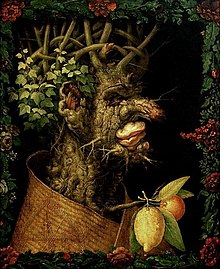
Giuseppe Arcimboldo, Winter, 1573. The concept of the "Tree-human", the hybrid organism, likewise the engorged fruit, all bear hallmarks of Bosch's Garden.
David Teniers the Younger (c. 1610–1690) was a Flemish painter who quoted both Bosch and Bruegel throughout his career in such works as his versions of the Temptation of St Anthony, the Rich Man in Hell and his version of Mad 1000000.
During the early 20th century, Bosch's piece of work enjoyed a pop resurrection. The early surrealists' fascination with dreamscapes, the autonomy of the imagination, and a free-flowing connection to the unconscious brought about a renewed interest in his piece of work. Bosch's imagery struck a chord with Joan Miró[100] and Salvador Dalí[101] in particular. Both knew his paintings firsthand, having seen The Garden of Earthly Delights in the Museo del Prado, and both regarded him every bit an fine art-historical mentor. Miró'due south The Tilled Field contains several parallels to Bosch'southward Garden: like flocks of birds; pools from which living creatures emerge; and oversize disembodied ears all echo the Dutch primary's piece of work.[100] Dalí's 1929 The Bang-up Masturbator is like to an prototype on the correct side of the left panel of Bosch's Garden, equanimous of rocks, bushes and little animals resembling a face with a prominent nose and long eyelashes.[102]
When André Breton wrote his commencement Surrealist Manifesto in 1924, his historical precedents equally inclusions named only Gustave Moreau, Georges Seurat, and Uccello. However, the Surrealist motility soon rediscovered Bosch and Bruegel, who chop-chop became popular amidst the Surrealist painters. René Magritte and Max Ernst[103] both were inspired past Bosch'due south The Garden of Earthly Delights.
In the 2004 Polish picture The Garden of Earthly Delights (Ogród rozkoszy ziemskich), 2 lovers recreate some of the figures from the Bosch painting as tableau vivant performances in commemoration of life afterward the woman finds that she is dying.[104]
Notes [edit]
- ^ At the time, paintings often had no fixed titles. It is listed in Philip IV of Espana'south inventory equally La Pintura del Madroño. Information technology is known today in Castilian, at the Prado Museum, as El Jardín de las Delicias.
Citations [edit]
- ^ Bosch'south verbal date of nascency is unknown simply is estimated to be 1450. Gibson, 15–16
- ^ Belting, 85–86
- ^ Gibson, 99
- ^ a b c von Baldass, 33
- ^ a b Snyder 1977, 102
- ^ a b c Belting, 21
- ^ Veen & Ridderbos, vi
- ^ The drenched state of the Earth has led some to translate the panels as depicting The Flood. In Mann, 2005
- ^ Belting, 22
- ^ Gibson, 88
- ^ Dempsey, Charles. "Sicut in utrem aquas maris: Jerome Bosch'southward Prolegomenon to the Garden of Earthly Delights". MLN. The Johns Hopkins University Printing, 119:1, Jan 2004. S247–S270. Retrieved Nov 14, 2007
- ^ Cinotti, 100
- ^ a b Calas, Elena. "D for Deus and Diabolus. The Iconography of Hieronymus Bosch". The Periodical of Aesthetics and Art Criticism, Volume 27, No. 4, Summer, 1969. 445–454
- ^ Glum, 45
- ^ a b c Belting, 57
- ^ Gibson, 91
- ^ a b c Dixon, Laurinda Southward. "Bosch'southward Garden of Delights: Remnants of a 'Fossil' Science". Fine art Bulletin, LXIII, 1981. 96–113
- ^ a b c d Gibson, 92
- ^ Fraenger, 44
- ^ a b Gibson, 25
- ^ Fraenger, 46
- ^ a b c Belting, 26
- ^ a b Tuttle, Virginia. "Lilith in Bosch's 'Garden of Earthly Delights'". Simiolus: Netherlands Quarterly for the History of Art, Volume fifteen, No. 2, 1985. 119
- ^ Gibson, 92–93
- ^ Fraenger, 122
- ^ Linfert, 106–108
- ^ Mann, Richard G. "Melanie Klier's: Hieronymus Bosch: Garden of Earthly Delights". Utopian Studies, xvi.1, 2005
- ^ a b Belting, 47
- ^ Gibson, 80
- ^ a b c Fraenger, 10
- ^ a b c d Gibson, 85
- ^ Reuterswärd, Patrik. "A New Clue to Bosch'south Garden of Delights". The Art Message, Book 64, No. 4, December 1982. 636–638: 637
- ^ Glum 2007, 253–256
- ^ a b Fraenger, 139
- ^ a b Reuterswärd, 636
- ^ Belting, 48–54
- ^ Glum, 51
- ^ Belting, 54
- ^ Fraenger, 11
- ^ a b Fraenger, 135
- ^ Fraenger, 136
- ^ a b c d e Belting, 38
- ^ a b c d Belting, 35
- ^ Belting, 44
- ^ Gibson, 96
- ^ Harbison, 79
- ^ a b c Gibson, 97–98
- ^ Gibson, 82
- ^ a b Bosing, lx
- ^ Baldass, Ludwig von, "Die Chronologie der Gemälde des Hieronymus Bosch", in: Jahrbuch der königlichen Preuszischen Kunstsammlungen, XXXVIII (1917), pp. 177–195
- ^ Tolnay, Charles de Hieronymus Bosch. Basel, 1937
- ^ a b c d eastward Cinotti, 99
- ^ a b Glum 2007, 3
- ^ Vermet, Bernard M.. "Hieronymus Bosch: painter, workshop or style?" in Koldeweij et al. 2001a, 84–99:90–91. Extended argumentation in: Vermet, Bernard Chiliad.."Baldass was right" in Jheronimus Bosch. His Sources. 2nd International Jheronimus Bosch Briefing May 22–25, 2007 Jheronimus Bosch Art Heart. 's-Hertogenbosch 2010. ISBN 978-90-816227-4-v "Online".
- ^ Vermet 2010
- ^ a b This fact was but discovered by J. K. Steppe in 1962 (Jaarboek van de Koninklijke Vlaamse Academie voor Wegenschaften 24 [1962], 166–167), 20 years after Fraenger speculated the triptych was commissioned by the grand master of a heretical sect, but five years earlier Due east. H. Gombrich claimed to take discovered the Nassau provenance. In Belting, 71
- ^ Belting, 71
- ^ Moxey, 107–108. Works commissioned and endemic past churches or royalty are more likely to have surviving documentation
- ^ a b Silver, Larry. "Hieronymus Bosch, Tempter and Moralist". Per Contra: The International Periodical of the Arts, Literature and Ideas, Winter 2006–2007. Retrieved Apr 27, 2008
- ^ "Bosch and Bruegel: Inventions, Enigmas and Variations Archived 2007-06-09 at the Wayback Motorcar ". The National Gallery, London. Press release annal, November 2003. Retrieved May 26, 2008
- ^ Belting, 79–81
- ^ Harbison, 77–80
- ^ Snyder 1977, 96
- ^ Belting, 78
- ^ Vandenbroeck, Paul. "High stakes in Brussels, 1567. The Garden of Earthly Delights as the crux of the conflict between William the Silent and the Knuckles of Alva", in Koldeweij, et al. 2001b, 87–90
- ^ Larsen, 26
- ^ Prado, 36
- ^ "La restauración del Jardín de las delicias - Voz - Museo Nacional del Prado".
- ^ "New Bosch brandish at the Prado". Art History News. November 2020.
- ^ Fraenger, 1
- ^ a b Snyder 2004, 395–396
- ^ Gibson, sixteen
- ^ Gibson, 14
- ^ a b Gómez, 22
- ^ Fraenger, 57
- ^ Gibson, 27
- ^ Gibson, 26
- ^ Vandenbroeck, Paul. "The Spanish inventarios reales and Hieronymus Bosch", in Koldeweij et al., 49–63:59–60
- ^ Belting, 98–99
- ^ Smith, Jeffrey Chipps. "Netherlandish Artists and Art in Renaissance Nuremberg". Simiolus: Netherlands Quarterly for the History of Art, Volume 20, Number 2/3, 1990–1991. 153–167
- ^ Quoted in Moxey, 104.
- ^ Bosch was christened Jeroen van Aken only took surname Bosch from the boondocks he lived in for about of his life. Hieronymus is the Latin grade of Jerome. In Rooth, 12. ISBN 951-41-0673-3
- ^ Glum, 49
- ^ Gombrich, East. H. "Bosch's 'Garden of Earthly Delights': A Progress Report". Journal of the Warburg and Courtauld Institutes, Volume 32, 1969: 162–170
- ^ Grange Books, 23
- ^ von Baldass, 84
- ^ Glum, 1976
- ^ Bosing, 56
- ^ Snyder 1977, 100
- ^ Grange books, 37
- ^ Bosing, 51.
- ^ Grange Books, 32
- ^ Grange Books, 38
- ^ a b Linfert, 112
- ^ Spector, Nancy. "The Tilled Field, 1923–1924 Archived 2008-09-25 at the Wayback Car". Guggenheim display explanation. Retrieved May 30, 2008
- ^ Burness, Donald B. "Pieter Bruegel: Painter for Poets". Fine art Journal, Book 32, No. ii, Wintertime, 1972–1973. 157–162
- ^ Jones, Jonathan. "The stop of innocents". The Guardian, January 17, 2004. Retrieved May 27, 2008
- ^ "Mad Meg by Pieter Bruegel the Elder, 1561–62". Royal Museum of Fine Arts, Antwerp. Retrieved May 27, 2008
- ^ Kimmelman, Michael. "Arcimboldo's Feast for the Eyes". The New York Times, October 10, 2007. Retrieved May 27, 2008
- ^ a b Moray, Gerta. "Miró, Bosch and Fantasy Painting". The Burlington Magazine, Volume 113, No. 820, July 1971. 387–391
- ^ Fanés, Fèlix. Salvador Dalí: The Construction of the Image, 1925–1930. Yale University Press, March, 2007. 121. ISBN 0-300-09179-6
- ^ Félix Fanès: Salvador Dalí. The Structure of the Image 1925–1930. Yale University Press 2007, ISBN 978-0-300-09179-3, p. 74
- ^ Moray, Gerta. "Miró, Bosch and Fantasy Painting". The Burlington Magazine, Volume 113, No. 820, July 1971. Max Ernst's favourite painters and poets of the past, p. 387
- ^ Ágnes, Pethő (2015), ""Housing" a Deleuzian "Awareness:" Notes on the Mail service-Cinematic Tableaux Vivants of Lech Majewski, Sharunas Bartas and Ihor Podolchak", in Pethő, Ágnes (ed.), The Movie theater of Sensations, Cambridge Scholars Publishing, pp. 155, 157–158, ISBN978-1-4438-6883-nine
Sources [edit]
- Baldass, Ludwig von. Hieronymus Bosch. London: Thames and Hudson, 1960. ASIN B0007DNZR0
- Belting, Hans. Garden of Earthly Delights. Munich: Prestel, 2005. ISBN 3-7913-3320-eight.
- Bosing, Walter. Hieronymus Bosch, C. 1450–1516: Between Heaven and Hell. Berlin: Taschen, 2000. ISBN 3-8228-5856-0.
- Boulboullé, Guido, "Groteske Malaise. Dice Höllenphantasien des Hieronymus Bosch". In: Auffarth, Christoph and Kerth, Sonja (Eds): "Glaubensstreit und Gelächter: Reformation und Lachkultur im Mittelalter und in der Frühen Neuzeit", LIT Verlag Berlin, 2008, pp. 55–78.
- Cinotti, Mia. The Complete Paintings of Bosch. London: Weidenfeld and Nicolson, 1969.
- De Beatis, Antonio. The Travel Journal of Antonio De Beatis Through Germany, Switzerland, the Depression Countries, French republic and Italy, 1517–18. London: Hakluyt Club, 1999. ISBN 0-904180-07-seven.
- De Tolnay, Charles. Hieronymus Bosch. Tokyo: Eyre Methuen, 1975. ISBN 0-413-33280-ii. Original publication: Hieronymus Bosch, Basel: Holbein, 1937, 129 pages text, 128 pages images.
- Delevoy, Robert L. Bosch: Biographical and Disquisitional Study. Lausanne: Skira, 1960.
- Fraenger, Wilhelm and Kaiser, Ernst. The Millennium of Hieronymus Bosch. New York: Hacker Art Books, 1951. Original publication: Wilhelm Fraenger, Hieronymus Bosch – das Tausendjährige Reich. Grundzüge einer Auslegung, Winkler-Verlag Coburg 1947, 142 pages[ ISBN missing ]
- Gibson, Walter Due south. Hieronymus Bosch. New York: Thames and Hudson, 1973. ISBN 0-500-20134-X.
- Glum, Peter. "Divine Judgment in Bosch's 'Garden of Earthly Delights". The Fine art Bulletin, Volume 58, No. i, March 1976, 45–54.
- Glum, Peter. The key to Bosch's "Garden of Earthly Delights" found in allegorical Bible interpretation, Book I. Tokyo: Chio-koron Bijutsu Shuppan, 2007. ISBN 978-iv-8055-0545-8.
- Gómez, Isabel Mateo. "Hieronymus Bosch: The Garden of Earthly Delights". In Gaillard, J. and K. Hieronymus Bosch: The Garden of Earthly Delights. New York: Clarkson N. Potter, 1989. ISBN 0-517-57230-3.
- Harbison, Craig. The Art of the Northern Renaissance. London: Weidenfeld & Nicolson, 1995. ISBN 0-297-83512-two.
- Kleiner, Fred & Mamiya, Christian J. Gardner's Art Through the Ages. California: Wadsworth/Thompson Learning, 2005. ISBN 0-534-64091-5.
- Koldeweij, A. Thousand. (Jos) and Vandenbroeck, Paul and Vermet, Bernard M. Hieronymus Bosch: The Complete Paintings and Drawings. New York: Harry N. Abrams, 2001(a). ISBN 0-8109-6735-9.
- Koldeweij, A. Thousand. (Jos) and Vermet, Bernard M. with Kooy, Barbera van (edit.) Hieronymus Bosch: New Insights Into His Life and Work. New York: Harry North. Abrams, 2001(b). ISBN ninety-5662-214-5.
- Larsen, Erik. Hieronymus Bosch. New York: Smithmark, 1998. ISBN 0-7651-0865-8.
- Linfert, Carl (tr. Robert Erich Wolf). Bosch. London: Thames and Hudson, 1972. ISBN 0-500-09077-7. Original publication: Hieronymus Bosch – Gesamtausgabe der Gemälde, Köln: Phaidon Verlag 1959, 26 pages text, 93 pages images.
- Moxey, Keith. "Hieronymus Bosch and the 'World Upside Downwardly': The Case of The Garden of Earthly Delights". Visual Culture: Images and Interpretations. Connecticut: Wesleyan University Press, 1994, 104–140. ISBN 0-8195-6267-X.
- Oliveira, Paulo Martins, Jheronimus Bosch, 2012, ISBN 978-1-4791-6765-4.
- Pokorny, Erwin, "Hieronymus Bosch und das Paradies der Wollust". In: "Frühneuzeit-Info", Jg. 21, Heft ane+two (Sonderband "Die Sieben Todsünden in der Frühen Neuzeit"), 2010, pp. 22–34.
- Rooth, Anna Birgitta. Exploring the garden of delights: Essays in Bosch'due south paintings and the medieval mental culture. California: Suomalainen tiedeakatemia, 1992. ISBN 951-41-0673-three.
- Snyder, James. Hieronymus Bosch. New York: Excalibur Books, 1977. ISBN 0-89673-060-3.
- Snyder, James. The Northern Renaissance: Painting, Sculpture, the Graphic Arts from 1350 to 1575. 2nd edition. New Jersey: Prentice Hall, 2004. ISBN 0-thirteen-150547-five.
- Veen, Henk Van & Ridderbos, Bernhard. Early on Netherlandish Paintings: Rediscovery, Reception, and Inquiry. Amsterdam: Amsterdam University Printing, 2004. ISBN 90-5356-614-7.
- Vermet, Bernard One thousand. "Baldass was right" in Jheronimus Bosch. His Sources. 2nd International Jheronimus Bosch Conference May 22–25, 2007 Jheronimus Bosch Art Center. 's-Hertogenbosch 2010. ISBN 978-90-816227-iv-v "Online".
- Hieronymus Bosch. London: Grange Books, 2005. ISBN i-84013-657-10.
- Matthijs Ilsink, Jos Koldeweij, Hieronymus Bosch: Painter and Draughtsman – Catalogue raisonné, Mercatorfonds nv; 2016.
External links [edit]
- At the Museo Nacional del Prado
- "Bosch painted Garden of Earthly Delights for Brussels Palace" Audiovisual by Tvbrussel, 2016
- "The Garden of Earthly Delights: A diachronic interpretation of Hieronymus Bosch'south masterpiece" A lecture by Matthias Riedl
- Audiovisual tour of The Garden of Earthly Delights narrated by Redmond O'Hanlon
- Word by Janina Ramirez and Waldemar Januszczak: Fine art Detective Podcast, 25 Jan 2017
- Panorama of the painting
Source: https://en.wikipedia.org/wiki/The_Garden_of_Earthly_Delights

Post a Comment for "Creeping Crawling Thing Art Piece Bird Made of Hands"